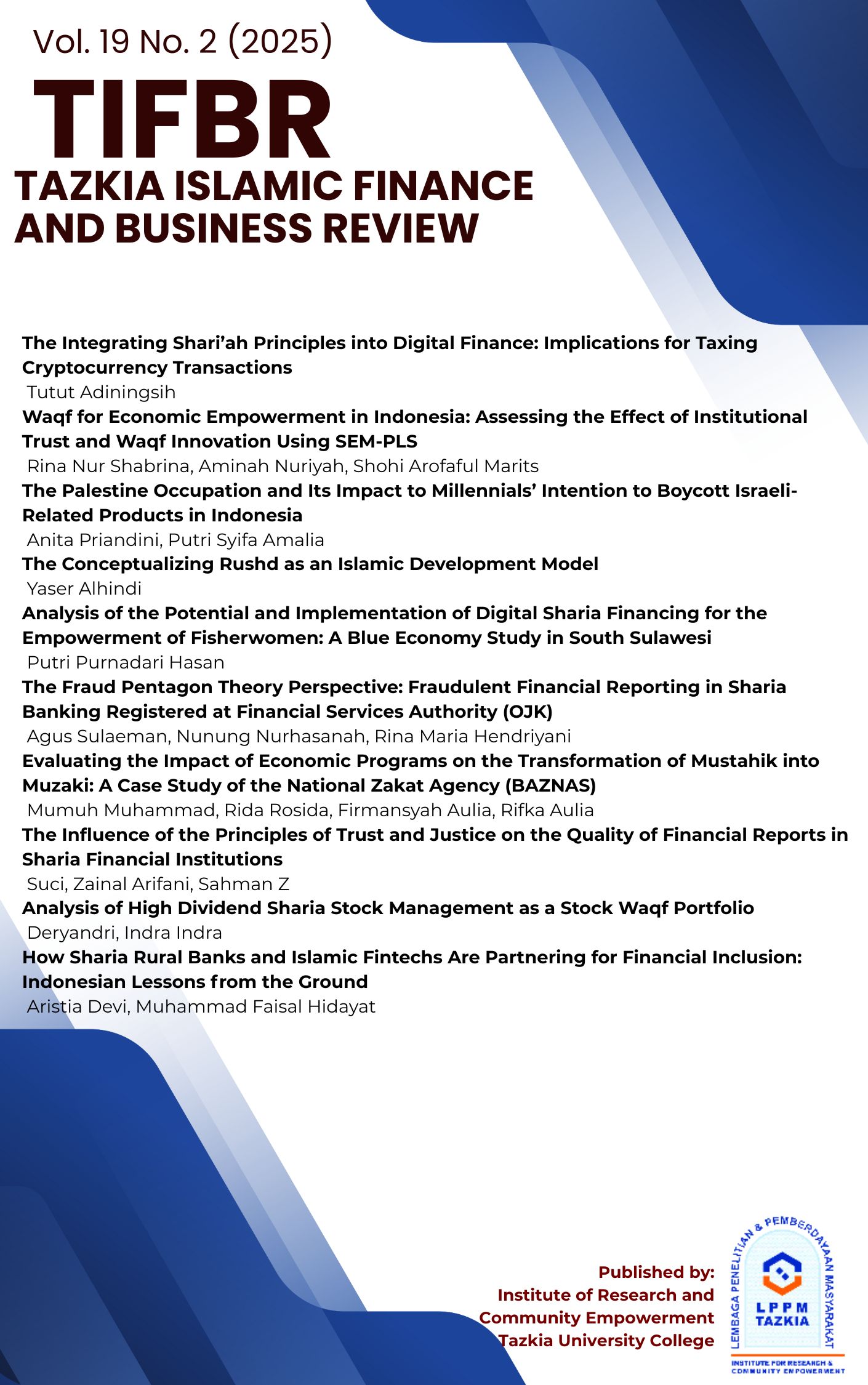
Waqf for Economic Empowerment in Indonesia: Assessing the Effect of Institutional Trust and Waqf Innovation Using SEM-PLS
DOI:
https://doi.org/10.30993/tifbr.v19i2.442الملخص
Waqf is an Islamic philanthropic instrument with significant potential to support sustainable economic empowerment in society. In Indonesia, the realization of productive waqf remains suboptimal, despite the estimated potential of cash waqf exceeding IDR 180 trillion annually. Low public participation in productive waqf is partly due to a lack of trust in waqf management institutions (institutional trust) and limited innovation in waqf practices (waqf innovation). This study aims to examine the influence of institutional trust and waqf innovation on waqf participation intention, and its impact on economic empowerment, with waqf participation intention as a mediating variable. A quantitative approach was employed using the Structural Equation Modeling – Partial Least Squares (SEM-PLS) method. Data were collected through an online questionnaire involving 150 Muslim respondents in Indonesia who are familiar with waqf programs. The results reveal that both institutional trust and waqf innovation significantly affect waqf participation intention. Furthermore, waqf participation intention positively influences economic empowerment and mediates the relationship between institutional trust, waqf innovation, and economic empowerment. These findings highlight the crucial role of enhancing trust and innovation in optimizing waqf as a sustainable and inclusive tool for economic empowerment in Indonesia.
التنزيلات
منشور
كيفية الاقتباس
إصدار
القسم
الرخصة
الحقوق الفكرية (c) 2025 Author and Publisher

هذا العمل مرخص بموجب Creative Commons Attribution-NonCommercial-ShareAlike 4.0 International License.

Tazkia Islamic Finance and Business Review (TIFBR) is licensed under a Creative Commons Attribution-NonCommercial 4.0 International License.
Authors who publish with this journal agree to the following terms:
- Authors retain copyright and grant the journal right of first publication with the work simultaneously licensed under a Creative Commons Attribution License that allows others to share the work with an acknowledgment of the work's authorship and initial publication in this journal.
- Authors are able to enter into separate, additional contractual arrangements for the non-exclusive distribution of the journal's published version of the work (e.g., post it to an institutional repository or publish it in a book), with an acknowledgment of its initial publication in this journal.
- Authors are permitted and encouraged to post their work online (e.g., in institutional repositories or on their website), as it can lead to productive exchanges, as well as earlier and greater citation of published work (See the Effect of Open Access).