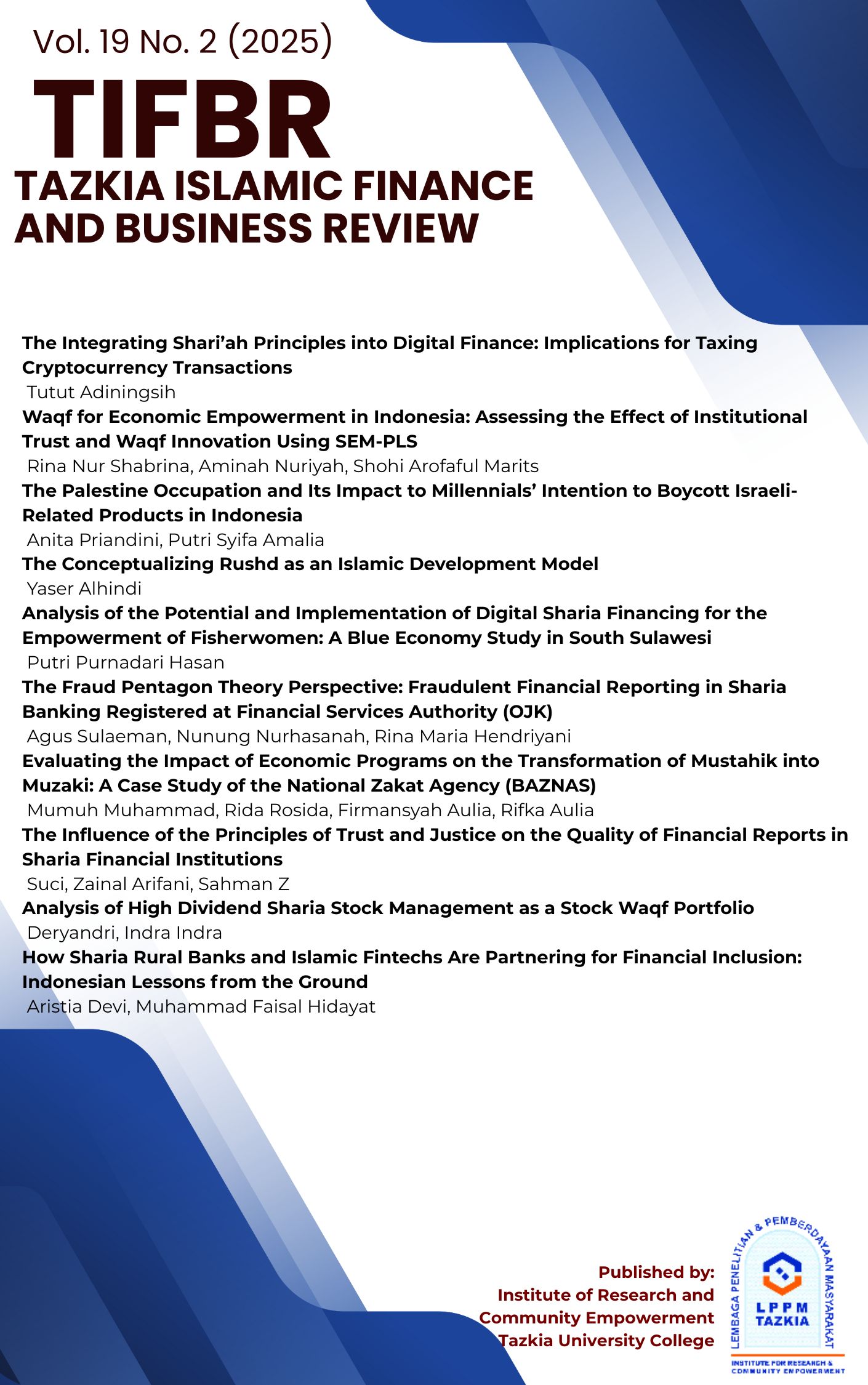
The Influence of the Principles of Trust and Justice on the Quality of Financial Reports in Sharia Financial Institutions
DOI:
https://doi.org/10.30993/tifbr.v19i2.458الملخص
This study aims to analyze the influence of trustworthiness and fairness on the quality of financial statements in Islamic financial institutions. Previous research that largely emphasized governance and compliance with Islamic principles shows that these ethical values need to be examined as key determinants of financial reporting integrity. Trustworthiness and fairness are considered highly relevant because they represent the moral foundation of Islamic financial practices, particularly in promoting transparency, accountability, and objectivity in the presentation of financial information. This study employs a quantitative approach using a Likert-scale questionnaire distributed to 144 respondents. The data were analyzed through validity and reliability testing as well as multiple linear regression to determine the effect of both variables on financial statement quality. The results indicate that the regression model used is statistically significant and capable of explaining the influence of trustworthiness and fairness on report quality. Trustworthiness contributes positively, while fairness demonstrates a more dominant and consistent influence in improving the quality of financial statements. Descriptive findings show average values of 74.39 (74%) for trustworthiness, 72.85 (73%) for fairness, and 73.91 (74%) for financial report quality, all categorized as high. These results confirm that trustworthiness and fairness function not only as moral values but also as strategic factors that strengthen the credibility and integrity of financial reporting.
التنزيلات
منشور
كيفية الاقتباس
إصدار
القسم
الرخصة
الحقوق الفكرية (c) 2025 Author and Publisher

هذا العمل مرخص بموجب Creative Commons Attribution-NonCommercial-ShareAlike 4.0 International License.

Tazkia Islamic Finance and Business Review (TIFBR) is licensed under a Creative Commons Attribution-NonCommercial 4.0 International License.
Authors who publish with this journal agree to the following terms:
- Authors retain copyright and grant the journal right of first publication with the work simultaneously licensed under a Creative Commons Attribution License that allows others to share the work with an acknowledgment of the work's authorship and initial publication in this journal.
- Authors are able to enter into separate, additional contractual arrangements for the non-exclusive distribution of the journal's published version of the work (e.g., post it to an institutional repository or publish it in a book), with an acknowledgment of its initial publication in this journal.
- Authors are permitted and encouraged to post their work online (e.g., in institutional repositories or on their website), as it can lead to productive exchanges, as well as earlier and greater citation of published work (See the Effect of Open Access).