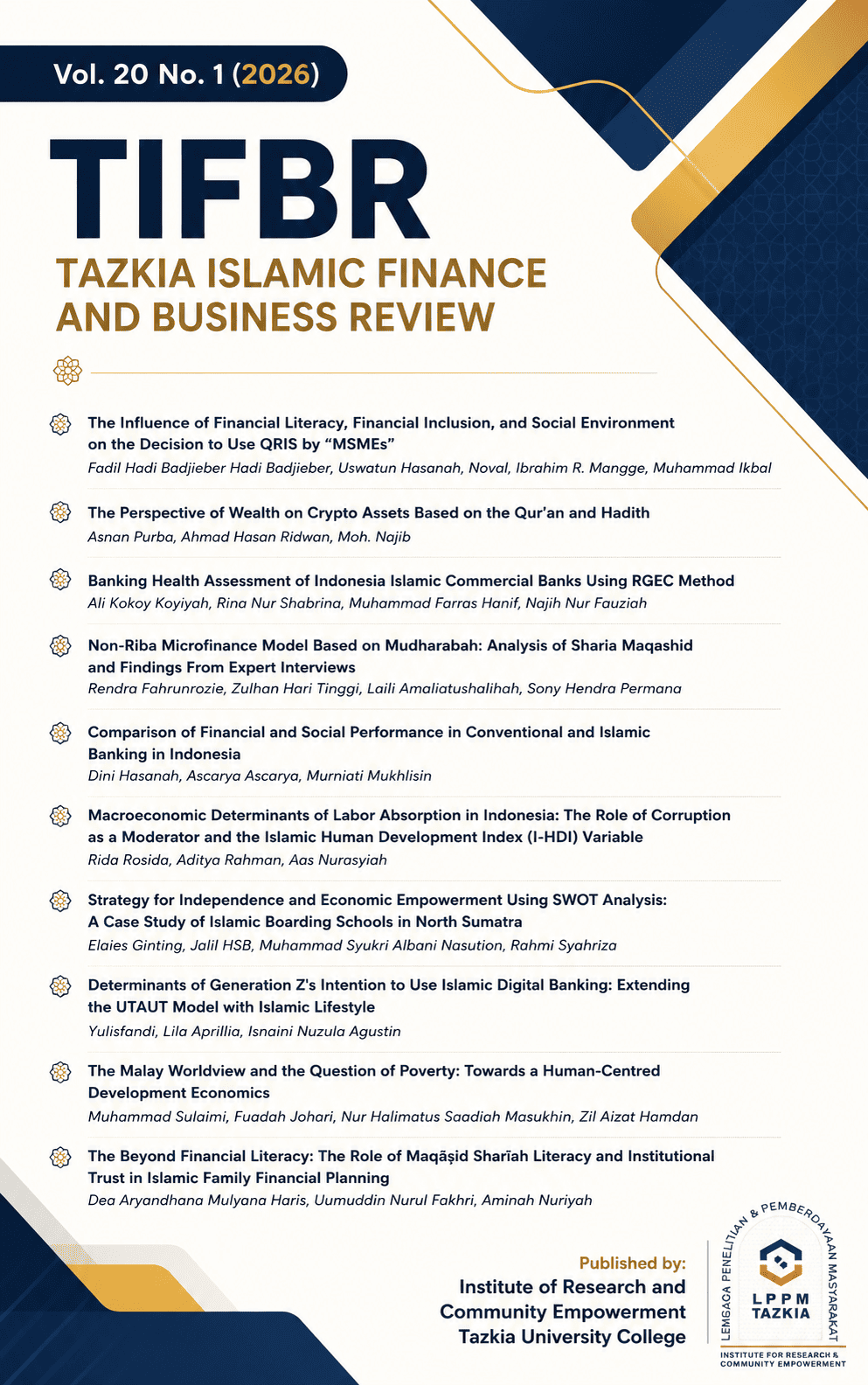
The Beyond Financial Literacy: The Role of Maqāṣid Shariah Literacy and Institutional Trust in Islamic Family Financial Planning
DOI:
https://doi.org/10.30993/tifbr.v20i1.540الملخص
This study examines the influence of Islamic Financial Literacy, Maqāṣid Shariah Literacy, and Trust in Islamic Financial Institutions on Competency in Islamic Family Financial Planning among Muslim households in West Java, Indonesia. A quantitative explanatory approach with a cross-sectional survey design was employed. Data were collected from 200 respondents through purposive sampling and analyzed using Partial Least Squares Structural Equation Modeling (PLS-SEM). The results reveal that Maqāṣid Shariah Literacy (β = 0.370, p < 0.001) and Trust in Islamic Financial Institutions (β = 0.455, p < 0.001) significantly enhance Islamic family financial planning competence, whereas Islamic Financial Literacy does not have a significant effect (β = 0.093, p = 0.257). The model accounts for 76.6% of the variance in the endogenous variable, indicating substantial explanatory power. These findings suggest that ethical values embedded in maqāṣid principles and institutional trust are more critical than technical financial knowledge in shaping Islamic financial capability. The study enriches the financial capability literature by emphasizing the role of value-based literacy and institutional confidence in promoting sustainable Islamic household financial management.
التنزيلات
منشور
كيفية الاقتباس
إصدار
القسم
الرخصة
الحقوق الفكرية (c) 2026 Author and Publisher

هذا العمل مرخص بموجب Creative Commons Attribution-NonCommercial-ShareAlike 4.0 International License.

Tazkia Islamic Finance and Business Review (TIFBR) is licensed under a Creative Commons Attribution-NonCommercial 4.0 International License.
Authors who publish with this journal agree to the following terms:
- Authors retain copyright and grant the journal right of first publication with the work simultaneously licensed under a Creative Commons Attribution License that allows others to share the work with an acknowledgment of the work's authorship and initial publication in this journal.
- Authors are able to enter into separate, additional contractual arrangements for the non-exclusive distribution of the journal's published version of the work (e.g., post it to an institutional repository or publish it in a book), with an acknowledgment of its initial publication in this journal.
- Authors are permitted and encouraged to post their work online (e.g., in institutional repositories or on their website), as it can lead to productive exchanges, as well as earlier and greater citation of published work (See the Effect of Open Access).