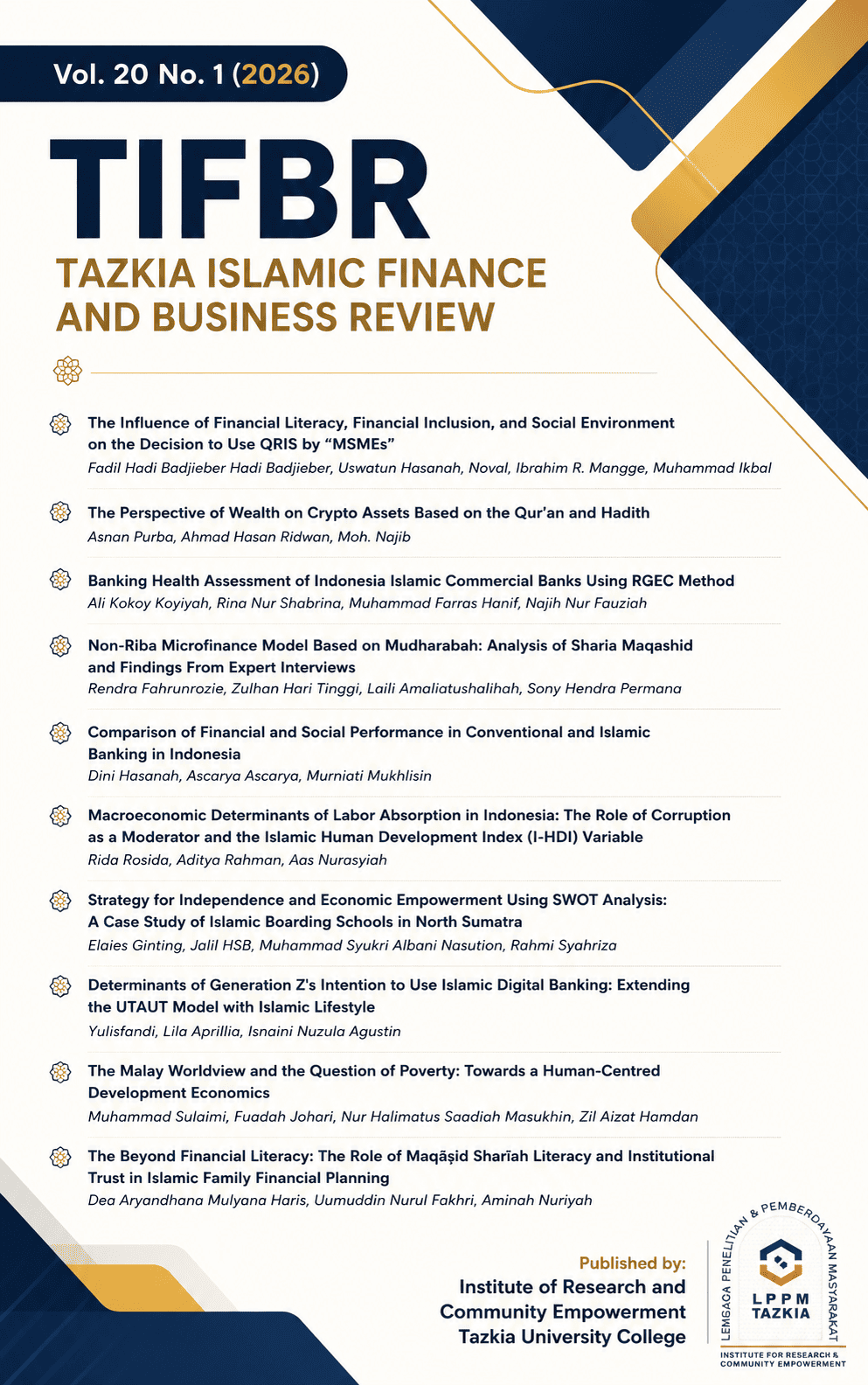
Comparison of financial and social performance in conventional and Islamic banking in Indonesia
DOI:
https://doi.org/10.30993/tifbr.v20i1.488Abstract
This study examines the comparison of financial and social efficiency between Islamic and conventional banks in Indonesia during the 2012–2020 period. Using a quantitative descriptive approach, the study applies Data Envelopment Analysis (DEA) with two models: the intermediation approach for financial efficiency and the production approach for social efficiency. The sample consists of 10 Islamic banks and 31 conventional banks selected from institutions consistently reporting CSR realization. The results indicate that Islamic banks demonstrate higher technical efficiency (TE) and pure technical efficiency (PTE) than conventional banks in both financial and social performance. However, financial efficiency values are consistently higher than social efficiency values for both banking types, indicating a stronger orientation toward financial performance. Scale efficiency (SE) in social performance shows conventional banks outperforming Islamic banks. The findings highlight the need for both banking systems to enhance social efficiency to achieve balanced two-dimensional efficiency aligned with sustainable finance principles.
Downloads
Published
How to Cite
Issue
Section
License
Copyright (c) 2026 Author and Publisher

This work is licensed under a Creative Commons Attribution-NonCommercial-ShareAlike 4.0 International License.

Tazkia Islamic Finance and Business Review (TIFBR) is licensed under a Creative Commons Attribution-NonCommercial 4.0 International License.
Authors who publish with this journal agree to the following terms:
- Authors retain copyright and grant the journal right of first publication with the work simultaneously licensed under a Creative Commons Attribution License that allows others to share the work with an acknowledgment of the work's authorship and initial publication in this journal.
- Authors are able to enter into separate, additional contractual arrangements for the non-exclusive distribution of the journal's published version of the work (e.g., post it to an institutional repository or publish it in a book), with an acknowledgment of its initial publication in this journal.
- Authors are permitted and encouraged to post their work online (e.g., in institutional repositories or on their website), as it can lead to productive exchanges, as well as earlier and greater citation of published work (See the Effect of Open Access).