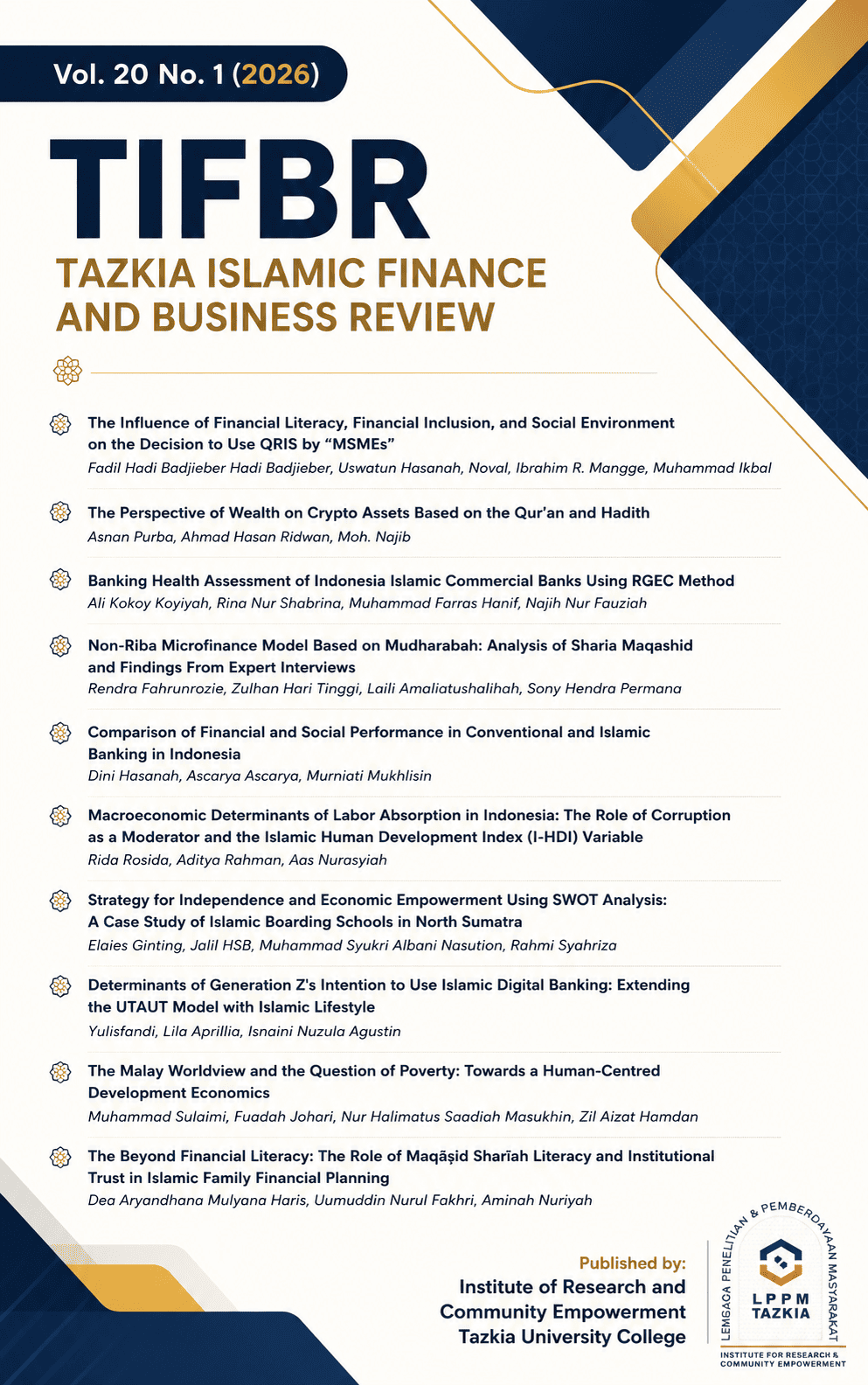
Macroeconomic Determinants of Labor Absorption in Indonesia: The Role of Corruption as a Moderator and the Islamic Human Development Index (I-HDI) Variable
DOI:
https://doi.org/10.30993/tifbr.v20i1.478Abstract
This study aims to examine labor absorption in Indonesia over the period 2021–2024. It also seeks to investigate the effects of economic growth, foreign direct investment (FDI), government expenditure, the Islamic Human Development Index (I-HDI), and inflation-moderated by corruption on labor absorption. The research employs a quantitative approach with hypothesis testing. Moderated Regression Analysis (MRA) is utilized as the primary analytical tool. The results reveal that economic growth, FDI, the I-HDI, and inflation exert significant effects on labor absorption, whereas government expenditure shows no significant impact. Furthermore, corruption significantly moderates the relationship between FDI, the I-HDI, and inflation with labor absorption. In contrast, corruption non-significantly moderates the correlation between economic growth or government expenditure and labor absorption.
Downloads
Published
How to Cite
Issue
Section
License
Copyright (c) 2026 Author and Publisher

This work is licensed under a Creative Commons Attribution-NonCommercial-ShareAlike 4.0 International License.

Tazkia Islamic Finance and Business Review (TIFBR) is licensed under a Creative Commons Attribution-NonCommercial 4.0 International License.
Authors who publish with this journal agree to the following terms:
- Authors retain copyright and grant the journal right of first publication with the work simultaneously licensed under a Creative Commons Attribution License that allows others to share the work with an acknowledgment of the work's authorship and initial publication in this journal.
- Authors are able to enter into separate, additional contractual arrangements for the non-exclusive distribution of the journal's published version of the work (e.g., post it to an institutional repository or publish it in a book), with an acknowledgment of its initial publication in this journal.
- Authors are permitted and encouraged to post their work online (e.g., in institutional repositories or on their website), as it can lead to productive exchanges, as well as earlier and greater citation of published work (See the Effect of Open Access).