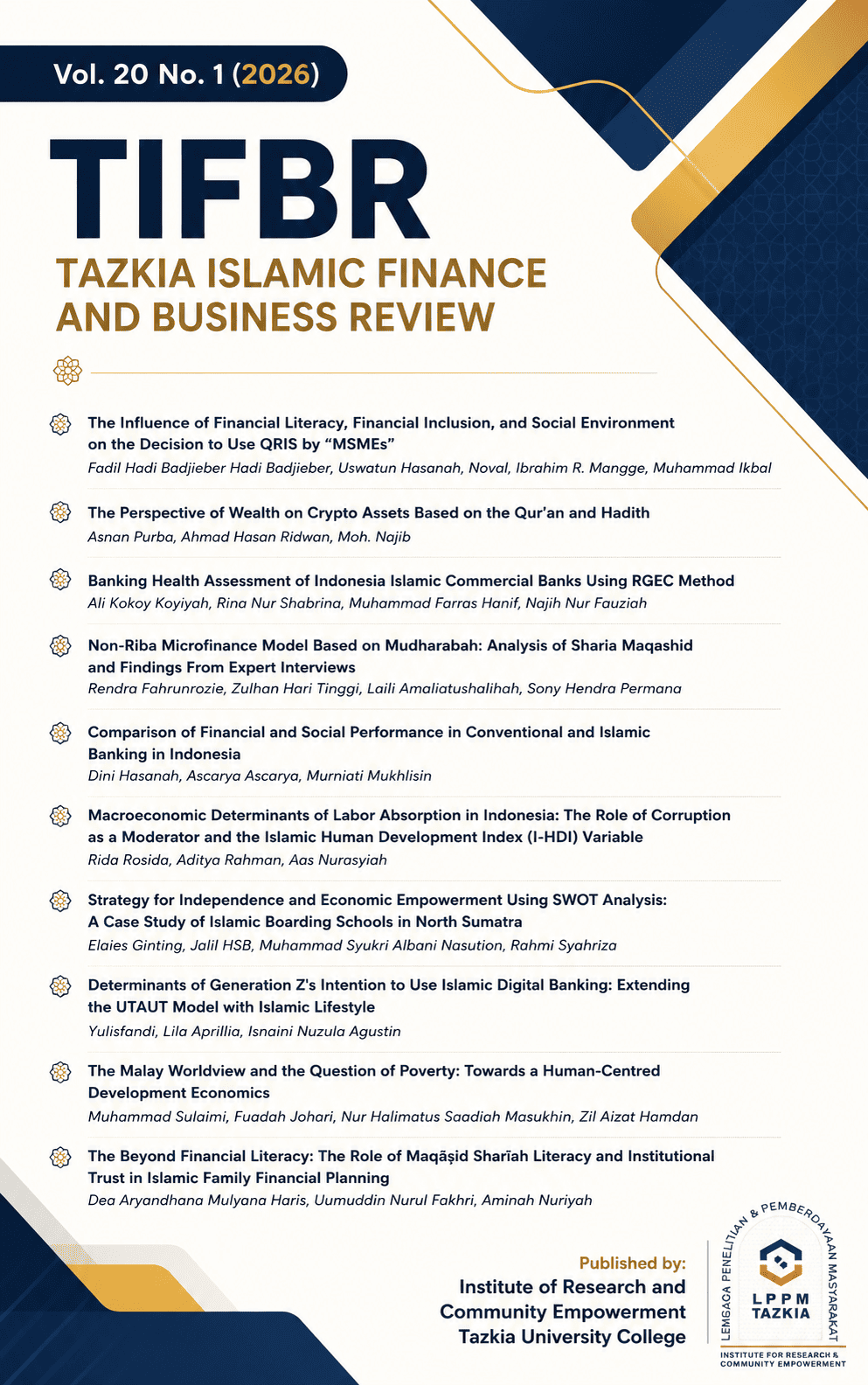
Macroeconomic Determinants of Labor Absorption in Indonesia: The Role of Corruption as a Moderator and the Islamic Human Development Index (I-HDI) Variable
DOI:
https://doi.org/10.30993/tifbr.v20i1.478Abstrak
Studi ini bertujuan untuk mengkaji tingkat penyerapan tenaga kerja di Indonesia selama periode 2021–2024 serta menganalisis pengaruh beberapa faktor ekonomi terhadapnya, dengan pendekatan kuantitatif melalui prosedur pengujian hipotesis dan teknik Moderated Regression Analysis (MRA). Hasil penelitian menunjukkan bahwa pertumbuhan ekonomi, investasi asing langsung (FDI), Islamic Human Development Index (I-HDI), serta tingkat inflasi berpengaruh signifikan terhadap penyerapan tenaga kerja, sementara pengeluaran pemerintah tidak memberikan pengaruh yang bermakna. Lebih lanjut, korupsi terbukti secara signifikan memoderasi hubungan antara FDI, I-HDI, dan inflasi dengan penyerapan tenaga kerja, namun tidak memoderasi hubungan antara pertumbuhan ekonomi maupun pengeluaran pemerintah dengan variabel tersebut.
##submission.downloads##
Diterbitkan
Cara Mengutip
Terbitan
Bagian
Lisensi
Hak Cipta (c) 2026 Author and Publisher

Artikel ini berlisensiCreative Commons Attribution-NonCommercial-ShareAlike 4.0 International License.

Tazkia Islamic Finance and Business Review (TIFBR) is licensed under a Creative Commons Attribution-NonCommercial 4.0 International License.
Authors who publish with this journal agree to the following terms:
- Authors retain copyright and grant the journal right of first publication with the work simultaneously licensed under a Creative Commons Attribution License that allows others to share the work with an acknowledgment of the work's authorship and initial publication in this journal.
- Authors are able to enter into separate, additional contractual arrangements for the non-exclusive distribution of the journal's published version of the work (e.g., post it to an institutional repository or publish it in a book), with an acknowledgment of its initial publication in this journal.
- Authors are permitted and encouraged to post their work online (e.g., in institutional repositories or on their website), as it can lead to productive exchanges, as well as earlier and greater citation of published work (See the Effect of Open Access).