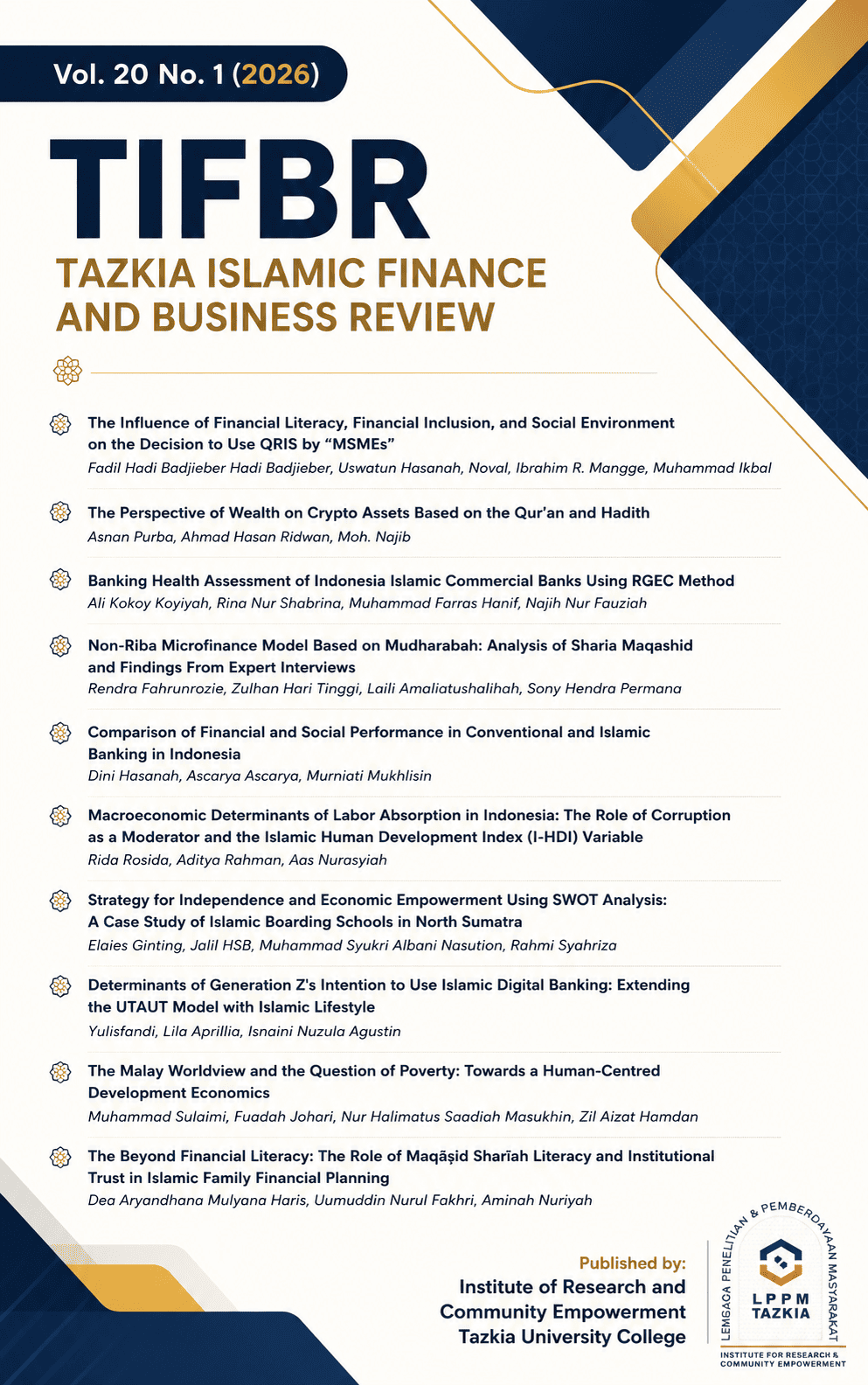
Determinants of Generation Z’s Intention to Use Islamic Digital Banking: Extending the UTAUT Model with Islamic Lifestyle
DOI:
https://doi.org/10.30993/tifbr.v20i1.519Abstract
This study aims to examine the factors influencing Generation Z’s intention to use digital banking by applying the Unified Theory of Acceptance and Use of Technology (UTAUT) model and investigating the moderating role of Islamic lifestyle. The study employs a quantitative approach using Partial Least Squares Structural Equation Modeling (PLS-SEM) through SmartPLS 4.0. The findings reveal that habit and trialability have a positive and significant effect on the intention to use digital banking, while hedonic motivation and price value do not show significant effects. In addition, Islamic lifestyle is not found to moderate the relationship between habit and intention to use digital banking. These results indicate that familiarity with technology and the opportunity to directly experience digital banking services are the key drivers of Islamic digital banking adoption among Generation Z. This study contributes to the digital banking and Islamic finance literature by extending the UTAUT framework through the inclusion of Islamic lifestyle and by providing empirical evidence on the behavioral determinants of digital banking adoption among Generation Z in the context of Islamic banking.
Downloads
Published
How to Cite
Issue
Section
License
Copyright (c) 2026 Author and Publisher

This work is licensed under a Creative Commons Attribution-NonCommercial-ShareAlike 4.0 International License.

Tazkia Islamic Finance and Business Review (TIFBR) is licensed under a Creative Commons Attribution-NonCommercial 4.0 International License.
Authors who publish with this journal agree to the following terms:
- Authors retain copyright and grant the journal right of first publication with the work simultaneously licensed under a Creative Commons Attribution License that allows others to share the work with an acknowledgment of the work's authorship and initial publication in this journal.
- Authors are able to enter into separate, additional contractual arrangements for the non-exclusive distribution of the journal's published version of the work (e.g., post it to an institutional repository or publish it in a book), with an acknowledgment of its initial publication in this journal.
- Authors are permitted and encouraged to post their work online (e.g., in institutional repositories or on their website), as it can lead to productive exchanges, as well as earlier and greater citation of published work (See the Effect of Open Access).