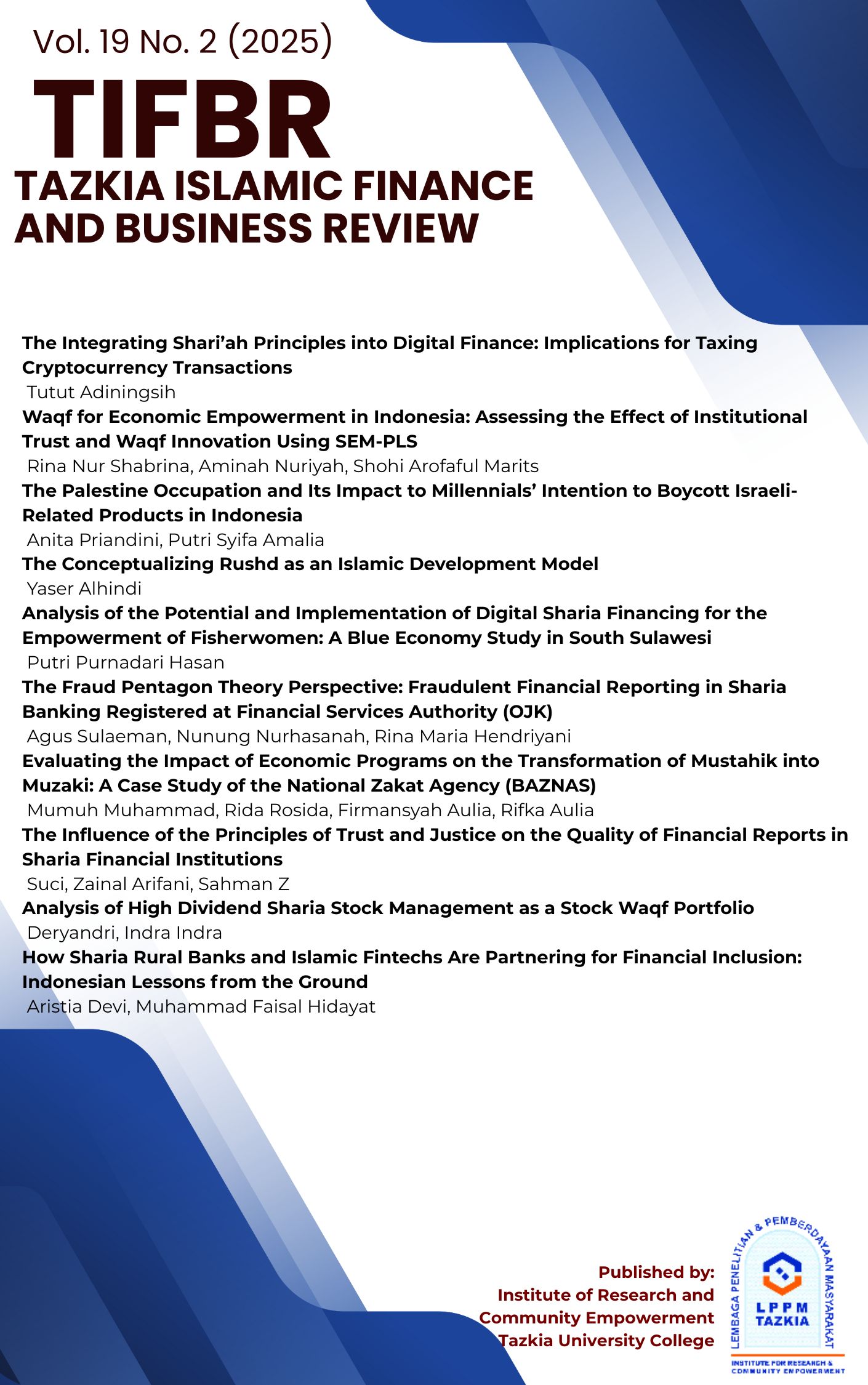
The Palestine Occupation and Its Impact to Millennial’s Intention to Boycott Israeli Related Products in Indonesia
DOI:
https://doi.org/10.30993/tifbr.v19i2.439الملخص
This study examines the impact of Palestine’s occupation on Indonesian millennials' intentions to boycott Israeli-affiliated products, focusing on attitude, perceived behavioral control, and subjective norm as determinants. Millennials are chosen as the research object based on the assumption that they represent an active workforce with relatively higher financial capability, potentially increasing their influence on consumer behavior. Using Structural Equation Modeling-Partial Least Squares (SEM-PLS), findings reveal that attitude and perceived behavioral control significantly impact boycott intention, while subjective norm is not significant. These results indicate that millennials are more influenced by personal beliefs and self-efficacy than by social pressures. Policy recommendations include enhancing educational campaigns to strengthen individual attitudes and empower millennials with resources for informed choices, possibly through collaborations with influencers and educational institutions. Future studies could explore additional factors, such as media influence and availability of alternatives, to provide a broader understanding of boycott behavior among millennials.
التنزيلات
منشور
كيفية الاقتباس
إصدار
القسم
الرخصة
الحقوق الفكرية (c) 2025 Author and Publisher

هذا العمل مرخص بموجب Creative Commons Attribution-NonCommercial-ShareAlike 4.0 International License.

Tazkia Islamic Finance and Business Review (TIFBR) is licensed under a Creative Commons Attribution-NonCommercial 4.0 International License.
Authors who publish with this journal agree to the following terms:
- Authors retain copyright and grant the journal right of first publication with the work simultaneously licensed under a Creative Commons Attribution License that allows others to share the work with an acknowledgment of the work's authorship and initial publication in this journal.
- Authors are able to enter into separate, additional contractual arrangements for the non-exclusive distribution of the journal's published version of the work (e.g., post it to an institutional repository or publish it in a book), with an acknowledgment of its initial publication in this journal.
- Authors are permitted and encouraged to post their work online (e.g., in institutional repositories or on their website), as it can lead to productive exchanges, as well as earlier and greater citation of published work (See the Effect of Open Access).