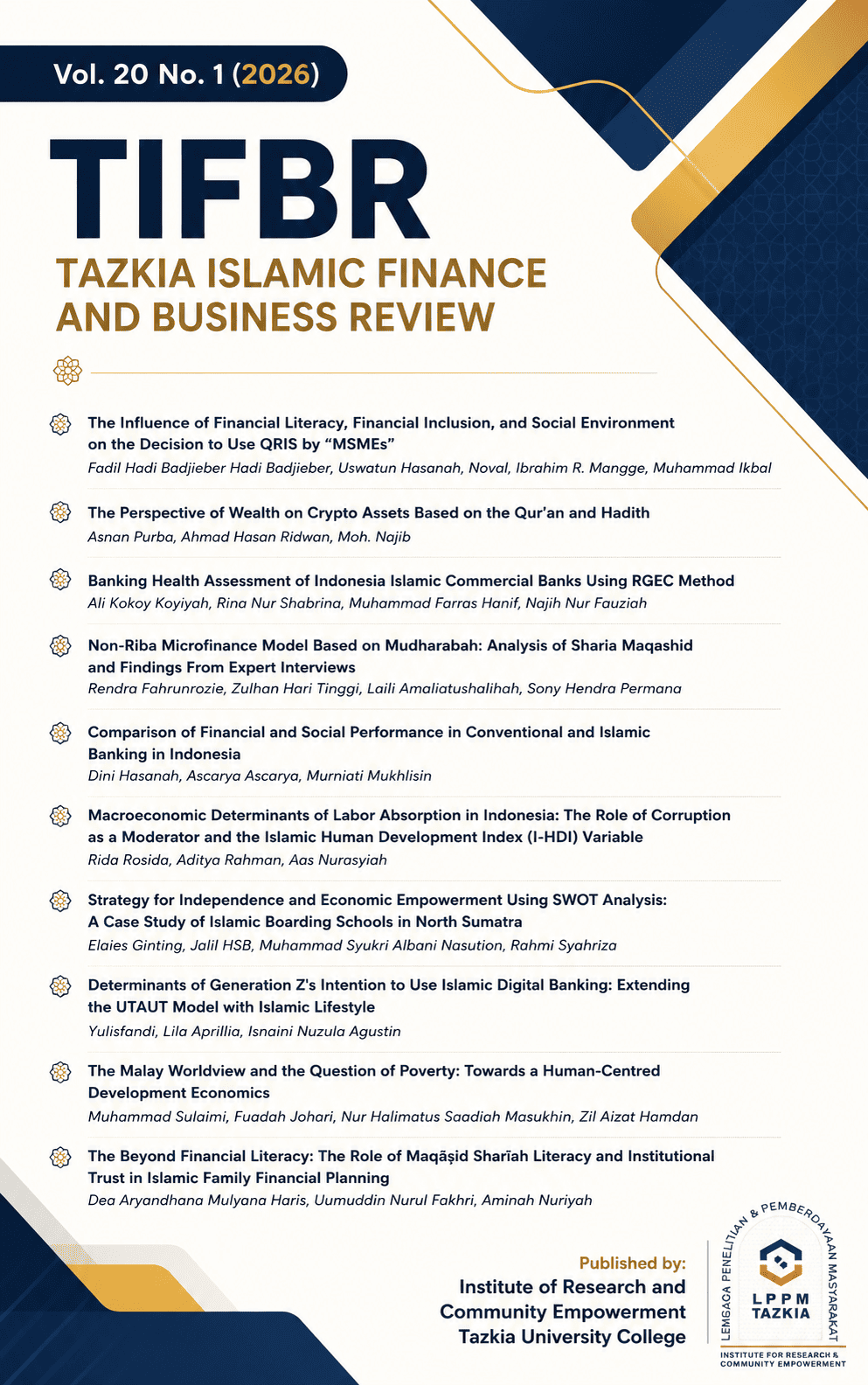
Banking health assessment of Indonesia Islamic Commercial Banks using RGEC Method
DOI:
https://doi.org/10.30993/tifbr.v20i1.504الملخص
This study analyzes the health level of Islamic Commercial Banks (BUS) in Indonesia in 2024 using the RGEC method, which consists of Risk Profile, Good Corporate Governance, Earnings, and Capital. A quantitative descriptive design is applied, using purposive sampling to select 13 BUS based on the availability of published annual financial reports. Secondary data were obtained through documentation and evaluated descriptively according to regulatory standards. The findings show that Islamic Commercial Banks are generally in a healthy condition. The average Non-Performing Financing (NPF) reached 1.1%, far below the 5% threshold, and most Financing to Deposit Ratios (FDR) were within the healthy range of 80–110%. In terms of governance, most banks received a “Good” rating for Good Corporate Governance (GCG). Profitability performance, measured by ROA and ROE, varied widely, with BTPN Syariah achieving the strongest results, while Bank Syariah Bukopin recorded the weakest performance due to negative ROA. All BUS displayed strong capital levels, indicated by Capital Adequacy Ratios (CAR) well above the 8% minimum. Overall, BUS health in 2024 is considered good, although several banks require improvement in profitability and intermediation. These results are useful for regulators, bank management, investors, and the public in making informed decisions.
التنزيلات
منشور
كيفية الاقتباس
إصدار
القسم
الرخصة
الحقوق الفكرية (c) 2026 Author and Publisher

هذا العمل مرخص بموجب Creative Commons Attribution-NonCommercial-ShareAlike 4.0 International License.

Tazkia Islamic Finance and Business Review (TIFBR) is licensed under a Creative Commons Attribution-NonCommercial 4.0 International License.
Authors who publish with this journal agree to the following terms:
- Authors retain copyright and grant the journal right of first publication with the work simultaneously licensed under a Creative Commons Attribution License that allows others to share the work with an acknowledgment of the work's authorship and initial publication in this journal.
- Authors are able to enter into separate, additional contractual arrangements for the non-exclusive distribution of the journal's published version of the work (e.g., post it to an institutional repository or publish it in a book), with an acknowledgment of its initial publication in this journal.
- Authors are permitted and encouraged to post their work online (e.g., in institutional repositories or on their website), as it can lead to productive exchanges, as well as earlier and greater citation of published work (See the Effect of Open Access).