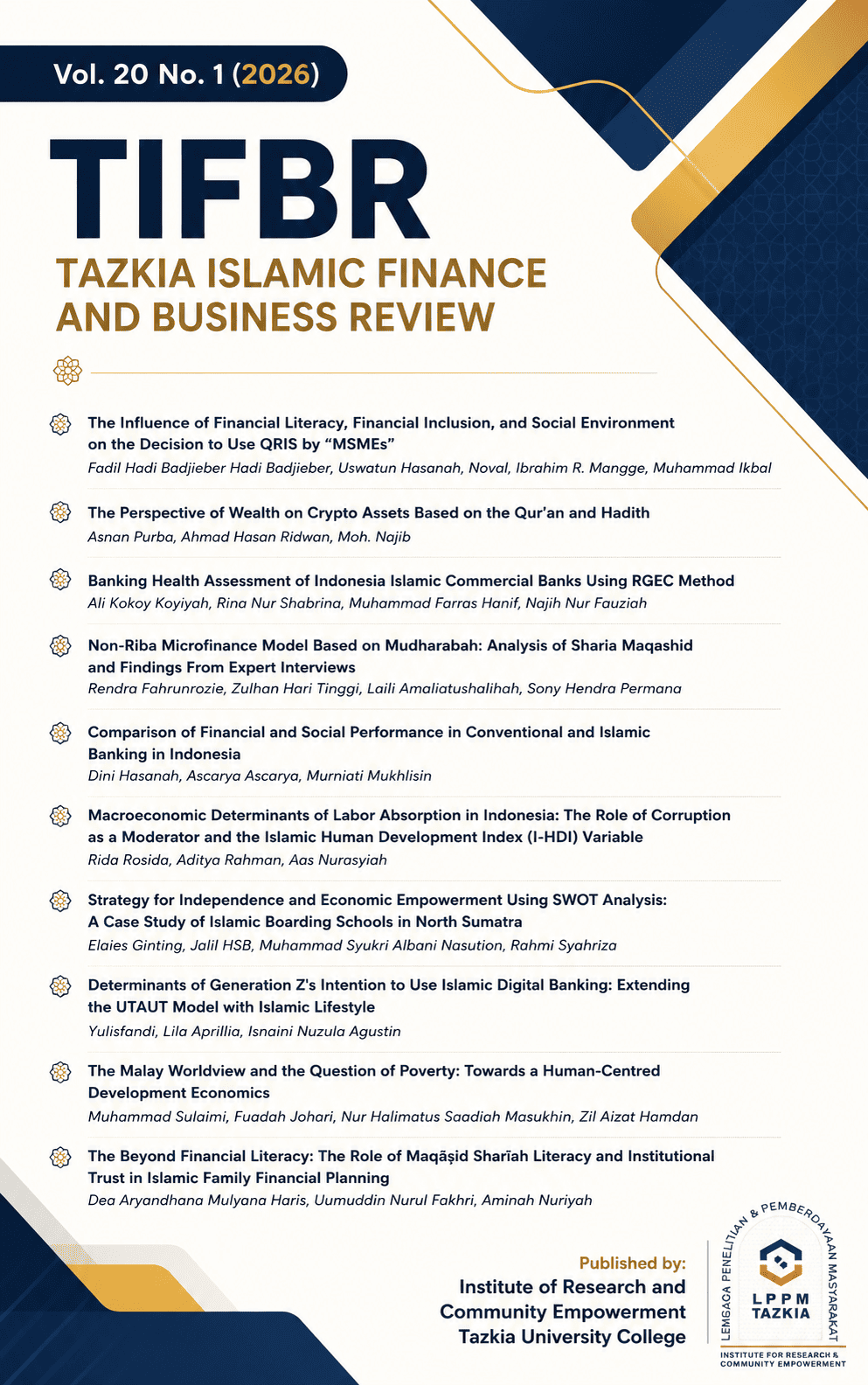
Strategy for Independence and Economic Empowerment Using SWOT Analysis: A Case Study of Islamic Boarding Schools in North Sumatra
DOI:
https://doi.org/10.30993/tifbr.v20i1.487Abstract
Islamic boarding schools (pesantren) have become a significant economic force in many regions in Indonesia. However, Islamic boarding schools often face challenges in terms of capital, management, market access, and infrastructure, making it difficult to maximize independence. Furthermore, the Islamic boarding school independence program is a strategic agenda mandated by Law Number 18 of 2019. Therefore, this research aims to develop strategies for independence and economic empowerment of Islamic boarding schools. This research is qualitative and inductive. The research location is an Islamic boarding school in North Sumatra. The data analysis used is a SWOT analysis. The results of the SWOT analysis indicate that Islamic boarding schools are positioned in an SO (Strength-Opportunities) strategy, a strategy that emphasizes utilizing internal strengths to seize and optimize available opportunities in developing Islamic boarding school businesses.
Keywords: Independence, Empowerment, Islamic Boarding Schools, SWOT.
Downloads
Published
How to Cite
Issue
Section
License
Copyright (c) 2026 Author and Publisher

This work is licensed under a Creative Commons Attribution-NonCommercial-ShareAlike 4.0 International License.

Tazkia Islamic Finance and Business Review (TIFBR) is licensed under a Creative Commons Attribution-NonCommercial 4.0 International License.
Authors who publish with this journal agree to the following terms:
- Authors retain copyright and grant the journal right of first publication with the work simultaneously licensed under a Creative Commons Attribution License that allows others to share the work with an acknowledgment of the work's authorship and initial publication in this journal.
- Authors are able to enter into separate, additional contractual arrangements for the non-exclusive distribution of the journal's published version of the work (e.g., post it to an institutional repository or publish it in a book), with an acknowledgment of its initial publication in this journal.
- Authors are permitted and encouraged to post their work online (e.g., in institutional repositories or on their website), as it can lead to productive exchanges, as well as earlier and greater citation of published work (See the Effect of Open Access).