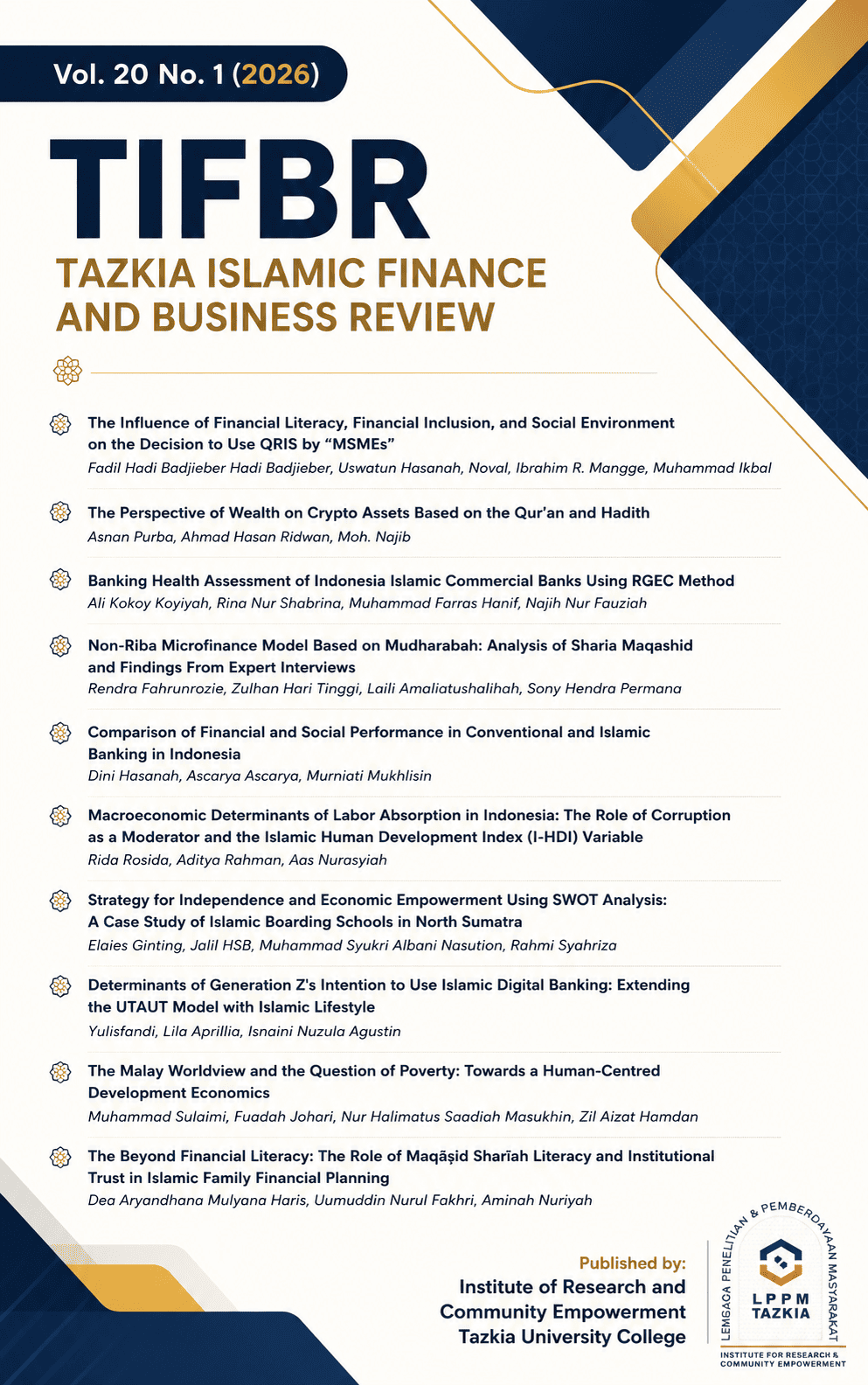
Strategy for Independence and Economic Empowerment Using SWOT Analysis: A Case Study of Islamic Boarding Schools in North Sumatra
DOI:
https://doi.org/10.30993/tifbr.v20i1.487Abstrak
Pesantren telah menjadi kekuatan ekonomi yang signifikan dibanyak wilayah di Indonesia. Namun, usaha pesantren kerap menghadapi tantangan dalam hal modal, manajemen, akses pasar, dan infrastruktur, menyebabkan keseulitan dalam memaksimalkan kemandirian. Disi lain program kemandirian pesantren merupakan agenda strategis yang diamanatkan dalam Undang-Undang Nomor 18 Tahun 2019. Oleh karena itu penelitian bertujuan strategi kemandirian dan pemberdayaan ekonomi pesantren . Jenis penelitian ini kualitatif induktif Lokasi penelitian pada Pesantren di Sumatera Utara. Analisis data yang digunakan adalah analisis SWOT. Diperloeh hasil analisis SWOT bahwa pesantren berada pada posisi strategi SO (Strength–Opportunities), yaitu strategi yang menekankan pada pemanfaatan kekuatan internal yang dimiliki untuk menangkap dan mengoptimalkan peluang yang tersedia dalam pengembangan usaha pesantren.
Kata Kunci : Kemandirian, Pemberdayaan, Pesantren, SWOT.
##submission.downloads##
Diterbitkan
Cara Mengutip
Terbitan
Bagian
Lisensi
Hak Cipta (c) 2026 Author and Publisher

Artikel ini berlisensiCreative Commons Attribution-NonCommercial-ShareAlike 4.0 International License.

Tazkia Islamic Finance and Business Review (TIFBR) is licensed under a Creative Commons Attribution-NonCommercial 4.0 International License.
Authors who publish with this journal agree to the following terms:
- Authors retain copyright and grant the journal right of first publication with the work simultaneously licensed under a Creative Commons Attribution License that allows others to share the work with an acknowledgment of the work's authorship and initial publication in this journal.
- Authors are able to enter into separate, additional contractual arrangements for the non-exclusive distribution of the journal's published version of the work (e.g., post it to an institutional repository or publish it in a book), with an acknowledgment of its initial publication in this journal.
- Authors are permitted and encouraged to post their work online (e.g., in institutional repositories or on their website), as it can lead to productive exchanges, as well as earlier and greater citation of published work (See the Effect of Open Access).